As I write this, I really don’t know what happened to Hunter. When he looked and felt his worst back in September, my biggest fear was that he wouldn’t live to see January 1st. I knew if he lived to January 1st, we would still have a few more years with him.
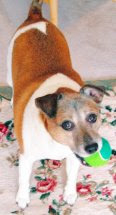
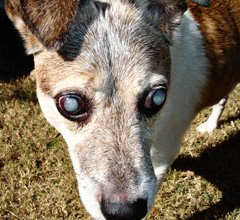
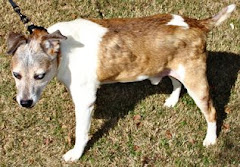
He had been doing so well. In the past, Hunter had always been a picky eater. Now, he was eating so well and was back to drinking a normal amount of water. He had even gained back 6 to 8 pounds and didn’t have bones sticking out anymore. His energy level had also increased and he was playing again. In fact, you wouldn’t know that anything was wrong with him except for the fact that he had cataracts. Even that wasn’t too noticeable anymore since he got around so well. I had really been feeling good about his progress and didn’t fear that he wouldn’t make it to January 1st.
I had taken Hunter back to GVS for his second ACTH test on December 15th. The test showed that his cortisol levels were perfect and just where the doctor wanted them to be. Hunter was still eating good and drinking close to 4 cups of water a day. I had asked about the hair loss and was told it was typical for them to lose a lot of hair due to the Lysodren.
Then I noticed on the 19th that he was consuming about 3 cups of water. I had figured Hunter’s weight to be around 32 pounds and I was beginning to be concerned. On the 20th, he consumed a little over 2 cups of water. So, on December 21st, we did a glucose curve. Hunter registered high, two hours after eating and having his insulin. It wasn’t until four hours later he started to register with his glucose being 338. Over the next several hours his numbers continued to drop and at 8 hours after his insulin his number was at 166, then 132 two hours later and at 12 hours after his insulin shot at 8:30 am, he was at 168. I fed him dinner and gave him his second shot at 8:30 pm, and at 10:30 pm, his numbers had gone back up to 351. I searched online and came across the term “food spike” or “sugar spike” for diabetics. I read that splitting up his meals into smaller ones can sometimes help this. Also, something told me to look-up how long I should be waiting to give him his shot. We were first initially told to give him his insulin shot within five minutes of him finishing eating. I found a pet center in London and a vet’s book online that said it was best to wait 30 minutes after a pet eats to give them the insulin shot, because the insulin would work better with the glucose.
December 23rd, I called GVS and left a message with the doctor that I had Hunter’s glucose curve numbers. He called me back that afternoon and after giving him Hunter’s number, he said to increase his insulin to 23 units. I asked the doctor if splitting up his feedings would help. He said to split his food into four feeding times. I told him that I was concerned about the drop in Hunter’s water consumption. Even though Hunter’s glucose numbers were high, he wasn’t that concerned with the drop in his water usage, because the biggest concern is water increase. My gut told me this wasn’t right.
Wednesday, December 24th, Hunter was leaving a lot of food in his bowl. Splitting his meals up, he was getting 1 cup for breakfast and two smaller meals of ½ cup every four hours until dinner time, when he would get 1 cup. He was eating a little over ½ cup for breakfast and dinner and barely touching the two snacks. He drank a little over a cup of water that day.
On Christmas, he was still eating less food. I was able to get him to drink a little more water. He didn’t eat his snacks at all. For dinner, he wasn’t that hungry so I poached an egg for him. I also added a ¼ cup of water to his food. He finally ate all his food. When I measured his water consumption he had drank a little over two cups. I was hoping we were making progress. Christmas dinner would be the last time he ate.
Friday, December 26th, I tried everything to get Hunter to eat. I scrambled eggs, I poached an egg, I even gave him some white rice, he would not eat. I boiled some chicken and I fed him a few pieces. He ate so little, I wasn’t able to give him his insulin shot. I even skipped giving him his L-thyroxine and Benadryl. He was drinking water though. I was so upset and frantic to find anything to get him to eat. I even tried wet food and sprinkled some garlic on it. He would just turn his head. I sat next to him, rubbing him and talking to him. I told him how much I loved him, like I did every day, and told him to fight.
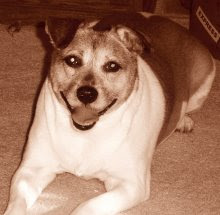
Hunter had the most beautiful brown eyes that would make my heart melt. I looked into his eyes and I could tell he was sad and tired. I didn't want to believe I was losing him and decided I would fight one last time.
We went to a pet store and bought some high fiber food by Science Diet. We also bought some canned food by them. As soon as we got home I opened the canned food and tried to get him to eat. He still refused. He threw-up in the kitchen three times. It was yellow and appeared to be all the water he had drank. I again boiled some chicken and got him to eat a few pieces. I checked his glucose and it was “high.” It was around 6:30 pm and I decided to go ahead and give him his shot of insulin at 23 units. We checked his glucose around 8:30 pm and it had gone down to 441. Hunter was still showing no interest in food. He was quivering more and I was becoming more and more frightened. I decided to call the emergency vet hospital that was less than 10 minutes from where we live. They told me to bring him in.
During the day, I had been looking up what could be causing him not to eat and drink. I came across diabetic ketoacidosis or DKA. DKA is when there is an elevated concentration of blood sugar and the presence of ketones in the urine and reduced concentrations of bicarbonate in the blood. Ketones or ketone bodies, are used for energy in the body’s tissues and form when fatty acids are released from fatty tissue. The liver makes ketones from the fatty acids. DKA happens when there is an excessive production of ketones when diabetes is uncontrolled. If Hunter had DKA, he would need intravenous fluids and a short-acting insulin to bring his glucose under control immediately.
I mentioned to the emergency veterinary doctor, Dr. Lee, that my concern was that Hunter might have DKA. She said they would run a test for this and examine him. She wanted to keep Hunter over night and possibly over the weekend to administer fluids and try to get his glucose under control. Her shift ended at 8 the next morning and she would call me before she left to let me know how Hunter was doing.
Dr Lee called me the next morning, December 27, and told me the urine test for ketones was negative. To double check that, she also checked for ketones using blood serum and it too came back negative.
When they checked his blood the night before, his electrolytes were off. I asked her that if this happened again, and Hunter’s water consumption decreased, was it ok to give him Pedialyte? She said this was a very good question and that she really wasn’t sure. I told her that I had checked to see if there was a Pedialyte product for diabetics and that I couldn’t find any, and that I knew it contained dextrose; however, I felt that perhaps it would be ok so he wouldn’t become dehydrated. She felt that it would probably be ok, for the short term.
Hunter’s liver enzymes were also elevated. For years, Hunter’s enzymes have always been off a little. He was also negative for a urine infection or any infection. She also told me that around 6 that morning, Hunter’s glucose registered at 57. This meant he was crashing and they gave him more dextrose, which raised his level to around 160. They had not given him any insulin, so this was from the shot I had given him the night before at 6:30.
Dr. Lee said we could visit Hunter in the afternoon and to bring his insulin and some food to see if he would eat. We went to visit him, and he was so happy. I can still see him coming into the room and the minute he heard our voices he perked up and began to wag his tail. He kept walking around and licking all of us in our faces. His body looked a lot fuller and his hair felt so soft. We tried to get him to eat his food and I knew he wouldn’t, and he didn’t. He just kept walking around and licking us. I was very pleased by how he looked and was hopeful he could come home.
Dr. Lee had said to give her a call after 8 pm to see if he was still doing well. She would then decide if he could come home.
I called a little after 8 that evening and spoke to her. They had re-checked his blood work and everything was now in the normal ranges. She asked me what I thought about how he looked. I told her he looked wonderful and his energy was up. So, we got ready to pick him up. Again, he was so happy that we were there. Dr. Lee talked to us about leaving his tubes in just in case we had to bring him back. The test would be to see if we could get him to eat. She went over the instructions for his insulin. If Hunter didn’t eat, he was to get just 6 units of insulin. However, if I could get him to eat, then I would give him 12 units. She felt that I needed to discuss adjusting the number of units of insulin I was giving him with the doctor at GVS. At this point, Dr. Lee was unsure what was going on with Hunter. She asked if he could have eaten anything toxic or if he had eaten anything out in the yard. He didn’t. In the back of my mind, the only thing toxic he had taken was Lysodren.
When we got home, Hunter urinated for the longest time. I realized that the stinker didn’t urinate the whole time he was there. I got his food ready and tapped the bowl. Hunter walked over and sniffed it and sniffed his water and then turned away. Panic waved over me. We tried to hand feed him and he turned away. I quickly boiled some chicken and again he turned away.
He went to his bedding and scratched at his baby blanket. He couldn’t get settled. He got up and seemed to roam around. He was not happy like he was earlier that day. His tail was tucked and we noticed that he was starting to quiver again.
We tried over and over again to get him to eat or drink and he would turn his head. We all talked to him and tried to get him to eat. He just wasn’t interested.
Again, Hunter tried to get comfortable and lay down. He then got up and had some dry heaves. I moved him and realized he had some diarrhea on him. I knew then he had to go back and we were all so torn. The hardest part was telling the girls that they might want to say a final goodbye to Hunter. Stefanie and Vivian didn’t want to hear that we would have to let him go. I told them that I would ask the doctor if he was dying, but they needed to prepare themselves. I prayed to God to give me the strength to do this.
I rode in the backseat with Hunter. I was praying the whole way there for help and the strength to do what was right for him. They took him to the back and we waited for Dr. Lee. We told her all that happened at home. She went back over his papers and said that all of his blood work looked good. There were no infections and no ketones, and his kidneys were functioning with no problems. She didn’t know what was going on unless he had an underlying condition that they weren’t able to detect. She said they could keep him on fluids and on Monday, I would need to take him back to GVS and see if they could do an ultrasound. Unfortunately, they didn’t have an ultrasound there. I told her that he had had an ultrasound in October and at that time, all of his organs were good and that there was nothing wrong except for his adrenal gland.
Joe mentioned that on the way in Hunter was pulling on the leash and he seemed so strong. Then I mentioned how good he looked when we visited him earlier and that it seemed like he crashed once we got him home. She said it was all due to adrenaline, and that she was afraid that once he got back home in his surroundings, that he would go downhill.
I then asked her if Hunter was dying. She looked at me and said, he has two strikes against him. I told her I couldn’t keep putting him through this. We then prepared to put him to sleep.
The tech came in and put a blanket on the floor and a second blanket to put over him. They brought him in and he perked up when he heard my voice. He came over to me and Joe, giving us both kisses. I got him to lay down and I put my arms around him. He didn’t try to get up and the tech put the blanket over him. He let me hold him and Joe was facing him. He was giving him kisses and I was telling him how much we all loved him. Dr. Lee came in and started the drug, and then he was gone. She hugged me and said that I did the right thing.
It’s taken me a few days to finish this. It’s now January 2, 2009 and in a little while, Vivian and I will go to Deceased Pet Care and bring our baby boy home for good. We had Hunter cremated and he's in a beautiful urn with dog prints.